
Introduction
Untitled Section
This is a Safeguarding Code of Practice issued under section 5A of the Safeguarding and Clergy Discipline Measure 2016, as amended by the Safeguarding (Code of Practice) Measure 2021.
The purpose of this code
This code imposes requirements on relevant persons to enable the assessment and management of safeguarding concerns and allegations. It also provides guidance to relevant persons on how to comply with the requirements. Both the requirements and guidance should be read together. The appendices contain further background and good practice advice.
The code is designed specifically for safeguarding officers and those who are involved in the management of cases.
It has become increasingly important to distinguish the purposes ofthe different processes that exist in respect of safeguarding, so that people are clear what to expect from each.
- First, there is the process for responding to, assessing and managing safeguarding concerns about individuals.This process is about the identification and management of risk through the Safeguarding Casework Management Group (SCMG, previously Core Group).
- Secondly, there are the processes which focus on responsibility and accountability for actions, including the establishment of guilt. These processes include criminal investigation and prosecution, disciplinary processes for those with contracts of employment, and complaints under the Clergy Discipline Measure (CDM)for those who are ordained.
- The third process, ‘learning lessons’, is about taking a step back to try to understand why the events happened in the way they did, and what were any underlying organisational and contextual issues which contributed to them. Answering the ‘why’ question enables an organisation to learn and make improvements that will keep people safe in the future. Without these underlying issues being identified and addressed, there remains a risk that unsafe practice and organisational factors continue.
The code focuses on concerns and allegations about church officers. However, the code also includes guidance on responding to concerns that do not involve church officers and on managing risks posed by other individuals in a church community.
The code aims to ensure that:
- any safeguarding risks are identified, assessed and managed appropriately;
- where required, statutory services are informed and involved, and there is ongoing partnership work with those agencies to ensure the safety of children, young people and vulnerable adults;
- complainants (individuals who raise concerns or allegations) and respondents (individuals who are the subjects of concerns or allegations)receive appropriate and coordinated responses,that have regard to their wellbeing; and
- all safeguarding concerns or allegations are assessed and managed,regardless of whether a threshold for disciplinary action againstthe subject ofthe concern or allegation has been met, which is particularly important from a prevention perspective. 6 This code is not:
- a criminal justice process. Where appropriate, an investigation will be carried out by the police and may be followed by prosecution.
- a disciplinary process. The processes set out in the code do not replace the Church’s disciplinary processes, any human resource policies and procedures, and any other local disciplinary policies.
However,the processes outlined in this code complement any action undertaken by statutory services such as police investigations or assessments by social services. Where relevant, the procedures outlined in this code should inform and assist both secular and church disciplinarily procedures and as far as possible should take place at the same time.
Overriding principles
The Church is not a single or uniform entity, but a multitude of organisations and communities bound together by
the love for God and the commitment to Christian values. Church bodies are supported by a range of individuals
and roles, including those who are office holders, employees, volunteers and those in elected roles. In addition, the Church serves parishioners and opens its doors to anyone who wishes to worship God. It is important, therefore, that safeguarding processes recognise this diversity and ensure that any risk assessment and management processes applied are tailored to specific roles and proportionate to the degree to which someone is involved with the Church.
The overriding principles under this code are:
- The safety and wellbeing of children, young people and vulnerable adults is paramount.
- Consistent with Christian theology and acceptance that each human being is made in the image
of God, complainants,respondents and others impacted by the concern or allegation will be treated
with dignity and respect. - Complainants and respondents will have access to appropriate support whilst action underthis code
is undertaken, recognising the potential of these processes to cause distress and lead to trauma. - The primacy of statutory processes and services is recognised, and responses to complainants and
respondents should meet legal requirements and be underpinned by guidance from the relevant statutory authorities (e.g.the police, social care). - Effective partnership work, within the Church and with relevant organisations and professionals outside
the Church, is key in ensuring that risks are effectively managed, processes are not duplicated, and
complainants and respondents receive coordinated responses. - The safeguarding processes underthis code should be carried outin a transparent manner, and
complainants and respondents will have access to information explaining these processes. - Complainants and respondents will have the opportunity to state their views, be listened to and be heard.
- The safeguarding processes underthis code should be conducted efficiently and seek to avoid delays.
- Clear records should be maintained at all stages, including records of key decisions, referrals and outcomes for all cases.
- Whilst the requirements set out in this code must be followed, in certain circumstances flexibility can
be applied to meetthe specific needs ofindividual complainants and respondents, orin orderto apply
the code effectively in specific church settings.This can only be done on the advice ofthe statutory
services or a Regional Safeguarding Lead (RSL) on behalf ofthe National Safeguarding Team (NST).
Legal framework
Section 5A of the Safeguarding and Clergy Discipline Measure 2016 was inserted by the Safeguarding
(Code of Practice) Measure 2021 and came into force on 1 March 2022.
The provisions replace the former ‘duty to have due regard’ with a duty for all relevant persons to comply
with the requirements of a code.
Where a requirement is imposed the code also gives guidance on how relevant persons can comply with the
requirement.The guidance sets out some good practice examples and explains why the requirementis necessary.
In other words, it explains ‘why and how’to deliverthe requirements. All requirements are marked as such and
are contained in a blue box.
Who is a 'relevant person'?
Each of the following is a relevant person:
a) a clerk in HolyOrders who is authorised to officiate in accordance with the Canons
b) an archbishop
c) a diocesan, suffragan or assistant bishop
d) an archdeacon
e) a person who is licensed to exercise the office ofreader or serve as a lay worker
f) a churchwarden
g) members of a parochial church council (PCC)
h) members ofthe chapter of a cathedral
i) the Diocesan Board of Education (DBE)for a diocese
j) the Diocesan Board of Finance (DBF)for a diocese
k) any other diocesan body as defined by section 19(1) of the Dioceses, Pastoral and Mission Measure 2007
l) a body established to carry out a mission initiative as defined by section 80(1) of the Mission and Pastoral Measure 2011
m) a person who is an officer or member of staff ofthe Archbishops’ Council, or who provides services to the Archbishops’ Council, and whose work to any extentrelates to safeguarding children and vulnerable adults
n) a person who works (on any basis) in a diocese or parish, or at a cathedral or for the purposes of a mission initiative, and whose work to any extent relates to safeguarding children and vulnerable adults.
At diocesan and parish level, different terms may be used to describe a lay worker or reader, according to a particular missional need. However, for the purposes of being a relevant person, the provisions extend to those who have been licensed to the office of reader or to serve as a lay worker by the bishop under Canon E5 or E6.
It is important to note that the relevant person is the one who has responsibility for making the requirement happen, and who has the ultimate accountability ifit doesn’t. That does not mean they are necessarily the person who will carry out the requirement. For example, if a bishop is a relevant person for a particular requirement, in practice this might be delegated to, for example, an archdeacon.
Enforcement
Failure by a member of the clergy to comply with a requirement under this code may constitute misconduct.
Failure by a reader orlay workerto comply with a requirement may be grounds forthe revocation ofthatreader’s
orlay worker’s licence. Other officers, such as churchwardens, may by suspended from office forfailing to comply
with a requirement underthe code. Breaches by trustee bodies, such as a PCC or a cathedral chapter, may also
trigger an intervention by the Charity Commission.
Application in the Diocese in Europe
This code must be followed in all the dioceses in the Church of England, including the Diocese in Europe.
However, itis recognised that specific considerations will need to be taken into account, which may impact on
how the requirements in this code can be met. In each case, any such considerations must be recorded and should include a clear explanation and rationale for how the underlying intent ofthe code is met.
Such considerations may include, but are notlimited to the following:
partners, agencies or services may be understood as the relevant equivalents within the respective country or territory in which a Diocese in Europe chaplaincy operates. Such structures and legal requirements may be different, and this may affect local practice, both in terms of emergency reporting and ongoing case management procedures. Similarly, local employment legislation and regulatory frameworks for charitable organisations may also differ.
The structure of the code
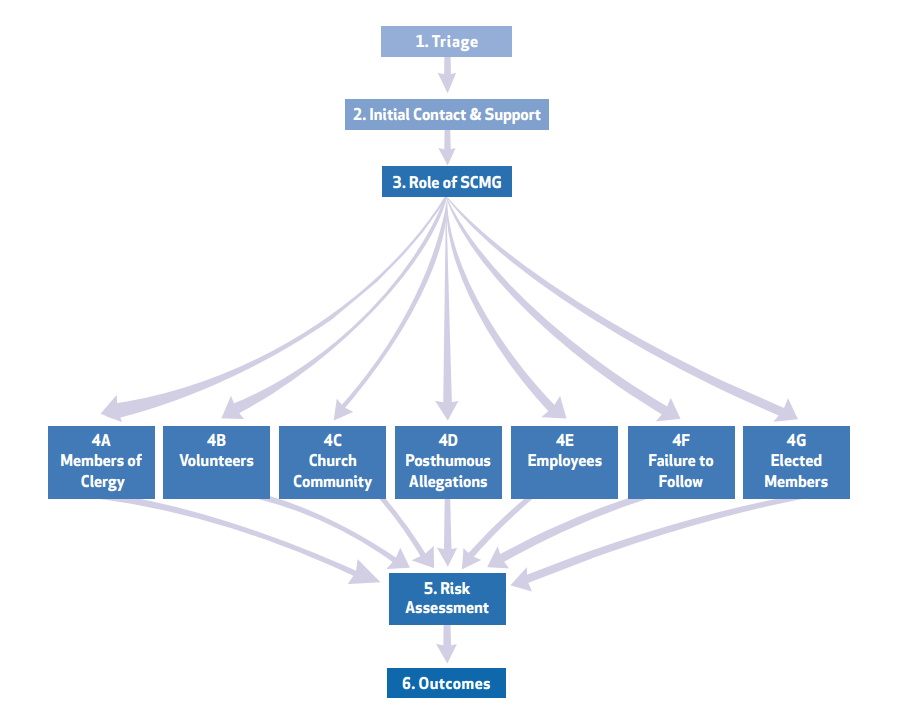
This code is structured into six sections, and includes core sections which apply to all allegations or concerns (green), and role specific pathways (yellow):
on how to determine which concerns or allegations are safeguarding matters and managed under
this code. It also provides guidance on how to respond to concerns or allegations aboutindividuals
who do not have a role in the Church. Section 2: Initial Contact and Support outlines the initial steps to be taken in each case, including
what support should be offered. Section 3: The Role of Safeguarding Case Management Groups provides the general operating
principles for SCMGs, which play a key role in the management of safeguarding concerns or
allegations within the Church. Section 4: Pathways details the specific steps that need to be undertaken when managing
safeguarding concerns/allegations about church officers depending on theirrole in the Church:
• Pathway 4A: Members of Clergy
• Pathway 4B: Lay Volunteers
• Pathway 4C: Managing Safeguarding Risks in the Church Community
• Pathway 4D: Managing Posthumous Safeguarding Concerns and Allegations
• Pathway 4E: Employees
• Pathway 4F: Failure to Follow Safeguarding Requirements
• Pathway 4G: Elected Members Section 5: Risk Assessment sets outthe principles and processes to be followed when assessing
and managing risk. Section 6: Outcomes, Closure and the Long-term risk Management of Risk gives a general outline
of how cases should be closed including resolutions and apologies.
Terminology
Bishop: This means the diocesan bishop, or where those functions have been delegated to another bishop,that
person. Where the word ‘bishop’ appears, it should be read to include ‘archbishop’, unless expressly stated otherwise.
Cathedral Safeguarding Officer (CSO): The person who maintains oversight of, leads and advises on safeguarding matters in a cathedral. A CSO could be a member of a Diocesan SafeguardingTeam (DST) or could be an officer employed directly by a cathedral.
Church bodies: For the purposes of this code, the term ‘church bodies’ means PCCs (including District Church
Councils and Guild Church Councils, or similar bodies), diocesan bodies (including DBFs and DBEs), cathedrals,
religious communities, mission initiatives (for example a Bishops’ Misson Order[BMO]), and the National Church
Institutions (NCIs).
Church officer: Any person appointed or elected by, or on behalf of, the Church to a post or role, whether they are ordained or lay, paid or unpaid. This covers a wide range of roles and is in effect anyone who is not purely a member of the congregation.This will therefore include clergy, staff, volunteers and elected members but would not include third party contractors.
Complainant: An individual who brings forward a safeguarding concern or allegation oris alleged to have suffered
abuse as a result of their engagement in the Church. The use of this term seeks to ensure that a degree of objectivity is maintained throughout the safeguarding process. It does not imply that a ‘complainant’ is not a victim or survivor. The use ofthe term ‘complainants’, instead of‘victims’ or‘survivors’, was a recommendation in past Lessons Learnt Case Reviews.
Diocesan Safeguarding Advisory Panel (DSAP): An independent advisory body offering external oversight and
scrutiny to the diocese regarding safeguarding.
Diocesan Safeguarding Officer (DSO): The person who maintains oversight of, leads and advises on safeguarding matters in a diocese. The functions of the DSO are set out in the Diocesan Safeguarding Officer Regulations 2024.
Note: DSOs have the authority to delegate tasks that would otherwise be their responsibility to Assistant Diocesan Safeguarding Officers (ADSOs), as and when appropriate. ADSOs are not specifically referenced in this code, but where a requirement is included that requires the DSO to undertake a certain action, the DSO can delegate that action to an ADSO within their team.
Local Authority Designated Officer (LADO): The individual employed by a local authority who is responsible
for overseeing allegations against adults who work with children.
National Safeguarding Casework Management System (NSCMS, My Concern): The system used by the dioceses, cathedrals and the NST to monitor safeguarding cases.
National Safeguarding Team (NST):1 The Church of England’s central safeguarding provision, supporting policy
development,training, major projects and investigating cases against senior clergy (e.g. bishops and deans),
and cases where there is a high degree ofinterest or complexity.
Parish Safeguarding Officer (PSO): This role is the first point of contactin a parish for all safeguarding matters.
This includes receiving disclosures, managing church safety plans and maintaining records.
Relevant person: Any person or body thatfalls within any ofthe categories listed in section 5A(2) ofthe
Safeguarding and Clergy Discipline Measure 2016.
Respondent: An individual who is the subject of a safeguarding concern or allegation.
Safeguarding Case Management Group (SCMG): The group that is set up to work with the safeguarding officer
to assess and manage risk on receipt of an allegation (previously known as a Core Group).
Safeguarding concern or allegation: A safeguarding concern arises where someone has suspicions about a person or situation, butthe reason has not yet been established. For example,there may be concerns about a child who often comes to Sunday School upset, dirty and hungry. An allegation is a more definite assertion,for example, if someone is witnessed hitting a child. For ease ofreading,the term ‘safeguarding allegation’ is used throughout, and is be taken to include safeguarding concerns.
Safeguarding officer: This term is used throughout this document to mean both the Diocesan and the Cathedral
Safeguarding Officer, as appropriate in the context.
_______________________________
1 For further information on specific responsibilities, see Key Roles and Responsibilities of ChurchOffice Holders
and Bodies Practice Guidance.pdf(churchofengland.org).