
Responding to safeguarding concerns or allegations that relate to children, young people and vulnerable adults
Report
Please note that if you believe that a child or adult is in immediate danger of significant or serious harm, you should contact the police on 999.
If a church officer notices signs or symptoms of potential abuse of a child or adult, you should report this to your activity leader/manager (where appropriate) and seek advice and guidance from the diocesan safeguarding adviser and/or the nominated safeguarding officer for your church body. This must happen within 24 hours of identifying a concern (see section 2).
If the information suggests that the child or adult is at risk of abuse or neglect, then the information will also need to be reported to the statutory services immediately (see section 2).
Introduction
This guidance is underpinned by the Church of England’s Safeguarding Policy Statement Promoting a Safer Church 2017, Ecclesiastical law and Government Guidance such as Working Together 2018 and the Care Act 2014. It replaces section 5 of Protecting All God’s Children 2010, including Annex A5 and Guidance Practice 2, and Appendix 3 of Promoting a Safe Church 2006. It replaces section 6 of Protecting All God’s Children and Promoting a Safe Church.
One of the key safeguarding policy commitments of the Church of England is that:
Anyone who brings any safeguarding suspicion, concern, knowledge or allegation of current or non-current abuse to the notice of the Church will be responded to respectfully and in a timely manner, in line with statutory child and adult safeguarding procedures and the House of Bishops’ Safeguarding Policy and Practice Guidance.
All safeguarding work will be recorded in line with the House of Bishops’ Safeguarding Practice Guidance.
All suspicions, concerns, knowledge or allegations, that reach the threshold for reporting to the statutory authorities, will be reported via the diocesan safeguarding adviser or designated safeguarding adviser/officer in another church body to the appropriate statutory authorities. This will be done irrespective of the status of the person.
Who is the guidance for?
This practice guidance is for use by all those who have a role with children, young people and vulnerable adults. This includes diocesan, cathedral and provincial safeguarding advisers [1] , members of the national safeguarding team, archbishops, bishops, deans and their senior staff.
It includes information that applies to parishes but, for ease of reference, this is also covered in the Parish Safeguarding Handbook.
It applies to all church bodies [2] and church officers [3] .
Under section 5 of the Safeguarding and Clergy Discipline Measure 2016, all authorised clergy, bishops, archdeacons, licensed readers and lay workers, church wardens and PCCs must have ‘due regard’ to safeguarding guidance issued by the House of Bishops. A duty to have ‘due regard’ to safeguarding guidance means that the person under the duty is not free to disregard it but is required to follow it unless there are cogent reasons for not doing so (‘cogent’ for this purpose means clear, logical and convincing). Failure by clergy to comply with the duty imposed by the 2016 Measure may result in disciplinary action. All decisions not to pay ‘due regard’ must be recorded and the reasons clearly stated.
This duty applies to this practice guidance.
In addition, failure to have due regard to the House of Bishops’ Safeguarding Policy and Practice Guidance may have direct consequences for the validity of your insurance.
When must this guidance be used?
This guidance must be used when there are concerns about the welfare and safeguarding of children, young people and/or adults that do not relate to church officers.
Please see ‘Responding to, Assessing and Managing Safeguarding Concerns or Allegations Against Church Officers’ for the procedure for dealing with concerns or allegations that relate to church officers.
If you are not sure whether a concern falls within this guidance, please consult your nominated safeguarding officer and/or the diocesan safeguarding adviser.
What does this guidance aim to do?
This guidance aims to offer the Church procedures for dealing with concerns or allegations against children, young people and adults, which are compliant with local safeguarding children’s and adults’ procedures. It offers guidance on:
- How to identify potential or actual harm to children, young people and adults;
- How to respond to direct concerns or allegations arising from a child, young person or adult;
- Reporting procedures to the Church’s nominated safeguarding professionals, who are able to offer advice and decide upon the necessity for a referral to children/adult social care and/or the police [4] ;
- What to expect from statutory agencies.
1. Be alert to safeguarding concerns
Church officers who come into contact with children, young people and/or adults, work with parents/carers, or gain knowledge about children and young people through working with adults should:
- Be alert to potential indicators of abuse or neglect [5] ;
- Be alert to the risks which abusers or potential abusers may pose to children, young people and/or adults;
- Be alert to the impact on the child, young person and/or adult of any concerns of abuse or maltreatment;
- Listen and respond well to any concerns or allegations;
- Report and record any concerns or allegations.
Safeguarding concerns or allegations may be about something that is going on now, something that may happen in the future, or something that happened in the past. Concerns or allegations about abuse in the past (called non-recent abuse) will be treated as seriously as abuse concerns or allegations which may be happening now.
There are many situations whereby a member of the Church may have concerns, or be made aware of concerns, regarding a child, young person and/or adult, such as when:
- A child, young person and/or adult discloses abuse;
- Someone discloses concern for a child, young person and/or adult;
- Someone notices signs of potential abuse of a child, young person and/or adult;
- A child, young person and/or adult makes a disclosure about their own behaviour towards another child, young person and/or adult;
- Someone witnesses concerning behaviours during a church activity or during a home visit.
1.1. Guidelines for responding to a person disclosing abuse
Whenever a child, young person and/or adult reports that they are suffering or have suffered significant harm through abuse or neglect, or have caused or are causing harm to others, the initial response should be limited to listening carefully to the child, young person and/or adult. If someone makes a disclosure this might be the only time they will tell someone about what is happening.
Respond
Do:
- Listen.
- Take what is said seriously.
- Only use open questions (open questions begin with words like: who, what, when, where and how. Open questions cannot be answered with a ‘yes’ or ‘no’).
- Remain calm.
- Take into account the person’s age and level of understanding.
- Check, if face to face, whether they mind you taking notes while they talk so you can make sure you capture the information accurately. At the end you can check with them that you have understood everything correctly.
- Offer reassurance that disclosing is the right thing to do.
- Establish only as much information as is needed to be able to tell your activity leader/manager/nominated safeguarding officer/DSA and statutory authorities what is believed to have happened, when and where.
- Check out what the person hopes to result from the disclosure.
- Tell the child or adult what you are going to do next.
Do not:
- Make promises that cannot be kept (e.g. that you won’t share the information).
- Make assumptions or offer alternative explanations.
- Investigate.
- Contact the person about whom allegations have been made.
- Do a physical or medical examination.
Record
- Make some very brief notes at the time, if appropriate, and write them up in detail as soon as possible.
- Record the date, time, place and the actual words used.
- Record facts and observable things, not your interpretations or assumptions.
- Don’t speculate or jump to conclusions.
Report
- If there is immediate danger to a child/adult, contact the police. Ring 999.
- Otherwise avoid delay and take action: talk immediately, within 24 hours, to your activity leader/manager/nominated safeguarding officer and share any concerns.
- Within 24 hours, the nominated safeguarding officer reports the concerns to the DSA.
- The DSA will advise regarding reporting to child/adult social care and/or the police (see section 2). This must be done within 24 hours.
If in any doubt seek advice from child/adult social care and/or the police.
Disclosure from a perpetrator
A disclosure may be made by someone who is a convicted offender or from someone who is disclosing previously unreported abuse. This information is more likely to be disclosed to those providing pastoral support; for example, clergy and pastoral workers.
The motive for admitting what has happened may be a desire to address the problem and obtain help. The person who admits to a potential offence against a child or adult must be told that the information will not be kept confidential and that the information will be passed on to child/adult social care and/or the police [6] .
Be supportive but do not seek more details than you need. Report within 24 hours what is believed to have happened to your activity leader/manager/the nominated safeguarding officer/the DSA and the statutory authorities.
1.2. How do I know that a child or young person is being abused?
Child abuse is a form of maltreatment of a child. Somebody may abuse or neglect a child by inflicting harm or by failing to act to prevent harm. Children may be abused in a family or in an institutional or community setting by those known to them or, more rarely, by others (e.g. via the internet). They may be abused by an adult or adults, or another child or children.
The term 'child' is used to include all children and young people who have not yet reached their 18th birthday.
Child abuse [7] is categorised as:
Physical abuse
Physical abuse may involve hitting, shaking, throwing, poisoning, burning or scalding, drowning, suffocating, or otherwise causing physical harm to a child. Physical harm may also be caused when a parent fabricates the symptoms of or deliberately induces illness in a child.
Sexual abuse
Sexual abuse involves forcing or enticing a child or young person to take part in sexual activities, not necessarily involving a high level of violence, whether or not the child is aware of what is happening. The activities may involve physical contact, including assault by penetration (e.g. rape or oral sex), or non-penetrative acts such as masturbation, kissing, rubbing and touching outside of clothing.
Sexual abuse includes non-contact activities, such as involving children in looking at, including online and with mobile phones, or in the production of pornographic materials, watching sexual activities, encouraging children to behave in sexually inappropriate ways, or grooming a child in preparation for abuse (including via the internet). Sexual abuse is not solely perpetrated by adult males. Women can also commit acts of sexual abuse, as can other children. In addition, sexual abuse includes abuse of children through sexual exploitation.
Emotional abuse
Emotional abuse is the persistent emotional maltreatment of a child, such as to cause severe and persistent effects on the child's emotional development, and may involve:
- Conveying to children that they are worthless or unloved, inadequate, or valued only insofar as they meet the needs of another person;
- Imposing age or developmentally inappropriate expectations on children. These may include interactions that are beyond the child's developmental capability, as well as overprotection and limitation of exploration and learning, or preventing the child from participating in normal social interaction;
- Seeing or hearing the ill-treatment of another, e.g. where there is domestic violence and abuse;
- Serious bullying, causing children to frequently feel frightened or in danger;
- Exploiting and corrupting children;
- Some level of emotional abuse is involved in all types of maltreatment of a child, though it may occur alone.
Neglect
Neglect is the persistent failure to meet a child's basic physical and/or psychological needs, and is likely to result in the serious impairment of the child's health or development.
Neglect may occur during pregnancy as a result of maternal substance misuse, maternal mental ill health, learning difficulties or a cluster of such issues. Where there is domestic abuse and violence towards a carer, the needs of the child may be neglected.
Once a child is born, neglect may involve a parent failing to:
- Provide adequate food, clothing and shelter (including exclusion from home or abandonment);
- Protect a child from physical and emotional harm or danger;
- Ensure adequate supervision (including the use of inadequate care-givers);
- Ensure access to appropriate medical care or treatment.
It may also include neglect of, or unresponsiveness to, a child's basic emotional, social and educational needs.
Included in the four categories of child abuse and neglect above are a number of factors relating to the behaviour of the parents and carers which have a significant impact on children, such as domestic violence. Research analysing serious case reviews has demonstrated a significant prevalence of domestic abuse in the history of families with children who are subject to statutory child protection plans. Children can be affected by seeing, hearing and living with domestic abuse, as well as by being caught up in any incidents directly, whether to protect someone or as a target. It should also be noted that the age group of 16 and 17 year olds has been found in recent studies to be increasingly affected by domestic violence in their peer relationships.
For further information on the signs and symptoms of abuse, see the Types of Abuse Fact Sheet.
1.3. How do I know that an adult is being abused?
The introduction of the Care Act 2014, which came into force in April 2015 [8] , put adult safeguarding on a statutory footing for the first time, embracing the principle that the ‘person knows best’. It laid the foundation for change in the way that care and support are provided to adults, encouraging greater self-determination, so people maintain independence and have real choice.
Some adults are particularly vulnerable to being hurt or abused because they have a disability, illness, or impairment, and need help and support. Being dependent on others can sometimes make them vulnerable and at risk of abuse, very often from people they know.
What is meant by adult abuse and neglect [9] ?
Adult abuse is the violation of an individual's human and civil rights by any other person or persons. Abuse happens when a person who is unable to protect themselves is ill-treated or neglected. It may be a one-off incident or may happen repeatedly over time.
Anyone can harm an adult who is not able to protect themselves – for example, a partner, relative, friend, neighbour or care worker – and the abuse may take place anywhere, in a public or private place.
Adult abuse [10] is categorised as:
Physical abuse – any form of assault, over-medication, restraint or poor manual handling practice.
Sexual abuse – rape or any sexual act which was not actively consented to or the person did not have the capacity to understand.
Psychological/emotional abuse – threats, intimidation, coercion, harassment or bullying.
Financial abuse – theft, borrowing money without repayment and any pressure in connection with wills, property, possessions or benefits.
Neglect or acts of omission – ignoring medical or physical needs, not providing access to appropriate care, or the withholding of the necessities of life, such as medication, adequate food, water and heating.
Discriminatory abuse – all forms of harassment, slurs or similar treatment based on a person's disability, ethnic origin, gender or sexuality. This is often called hate crime.
Institutional abuse – repeated instances of poor care, ill treatment of vulnerable adults, and unsatisfactory professional practice. This is often an indicator of more serious problems.
Modern slavery – slavery, human trafficking, forced labour and domestic servitude.
Self-neglect – this covers a wide range of behaviour, such as neglecting to care for personal hygiene, health or surroundings, and includes behaviour like hoarding which puts the person, or others, at risk.
Who might be an adult at risk of abuse or neglect?
An adult at risk of abuse or neglect is an adult who has care and support needs, and who may be unable to protect themselves from either the risk of or the experience of abuse or neglect.
Abuse or neglect of an adult with care and support needs could happen anywhere; for example, in their own home, in a care home or nursing home, a hostel, in supported living, in homes where people are in Shared Lives arrangements, or in hospital.
Examples of people who might be at risk of abuse or neglect include:
- Someone who is frail, due to ageing;
- Someone with a serious health condition;
- Someone with a physical disability;
- Someone with a visual impairment;
- Someone with a hearing impairment;
- Someone with a learning disability;
- Someone with a mental health difficulty;
- Someone who has memory problems or dementia;
- Victims of domestic violence;
- Someone who is addicted to drugs or other substances;
- A carer.
Please note that some adults may not consider themselves vulnerable to risk or neglect, but may be vulnerable to being abused by individuals in positions of leadership and responsibility. As adults are not inherently vulnerable and in need of protection, it is important to recognise that the factors described above, of themselves, do not mean that a person is vulnerable to abuse or neglect. It is a combination of these factors and the circumstances that a person finds him/herself in that can make an individual vulnerable to abuse or neglect.
Abuse happens to people in all sections of society.
For further information on the signs and symptom of abuse, see the Types of Abuse Fact Sheet.
2. Reporting a safeguarding concern or allegation about a child or young person
This is the procedure that church officers and bodies must follow if they have a safeguarding concern or allegation about a child or young person. Please see below for the procedure flow chart.
2.1. Quick guide

If a church officer becomes aware that a child has or is suffering significant harm [11] through abuse or neglect or is likely to suffer significant harm in the future, this must be reported to the nominated safeguarding officer and the DSA within 24 hours.
If through discussion with the DSA, it is decided that a child may be suffering or be at risk of suffering significant harm, concerns must always be referred to children’s social care. At this stage, a referral to the police may also be required if a crime has been committed [12] . Depending on the situation, the DSA may decide to refer the concerns themselves or support the church body to make the referral. The timing of such referrals should reflect the level of perceived risk of harm, but be within 24 hours of identification or disclosure of harm or risk of harm.
A referral to children's social care and other emergency services (e.g. for any urgent medical treatment) must not be delayed by the need for consultation with either the nominated safeguarding officer or the DSA if they are not available.
If the child is considered to be at immediate risk of harm or danger, then this must be reported to the police immediately. This may also require contacting the children’s social care, including the emergency duty team (if the concern arises outside of normal office hours).
Whilst those making referrals should seek, in general, to discuss any concerns with the family and, where possible, seek their agreement to make referrals, this should only be done where such discussion and agreement-seeking will not place a child at increased risk of significant harm. This should only be done after advice has been sought from the nominated safeguarding officer and/or the DSA (see section 2.3).
2.2. What will the diocesan safeguarding adviser do?
- Offer advice and support to a church body;
- Consider the child’s safety throughout;
- Check whether a referral to children’s social care and/or police is necessary. Agree next steps;
- Consider any support needs;
- Record case information;
- Consider whether a safeguarding agreement is required;
- Contact communications colleagues to discuss communications within the church, as required;
- Inform the diocesan secretary and/or registrar to agree if notification to charity commissions and the insurance company is necessary;
- Consider whether other colleagues or those in other organisations need to be informed, following advice from children’s social care/police.
2.3. Do I need to obtain consent?
All people over the age of 16 are presumed, in law, to have the capacity to give or withhold their consent to the sharing of confidential information, unless there is evidence to the contrary.
For a child or young person under the age of 16 who can understand the significance and consequences of making a referral to children's social care, they should be asked their view. However, it should be explained that whilst their view will be taken into account, the Church has a responsibility to take whatever action is required to ensure the child's safety and the safety of other children.
Where a child under 16 years of age is concerned, the consent of their parent or carer should be obtained before their personal information is shared. If this is not possible due to the urgency of the situation, they should be notified that information has been shared as soon as possible. Where a parent or carer has been implicated in the abuse, or the child will be placed at further risk of abuse by involving the parent or carer, the information can be shared without consent.
If in any doubt seek the advice of the DSA. Where a decision is made not to seek parental permission before making a referral to children's social care, the decision must be recorded in the case record, dated and signed, and confirmed in the referral to children's social care.
A child protection referral from a church officer cannot be treated as anonymous, so the parent will ultimately become aware of the identity of the referrer. Where the parent refuses to give permission for the referral, unless it would cause undue delay, further advice should be sought from the DSA and the outcome fully recorded.
If, having taken full account of the parent’s wishes, it is still considered that there is a need for referral:
- The reason for proceeding without parental agreement must be recorded;
- The parent's withholding of permission must form part of the verbal and written referral to children's social care;
- The parent should be contacted to inform them that, after considering their wishes, a referral has been made.
Urgent medical attention
If the child is suffering from a serious injury, the church officer must seek medical attention immediately from accident and emergency services, and must inform the parent/carer and the duty consultant paediatrician at the hospital. Where abuse is alleged, suspected or confirmed, the child must not be discharged until children's social care has been informed. They will work with the hospital and other agencies to address any immediate protection issues.
2.4. Making a referral to statutory agencies
- Referrals should be made to children's social care for the area where the child is living or is found. If a crime has also been committed, the police should also be contacted.
- If the child is known to have an allocated social worker, the referral should be made to them or in their absence to the social worker's manager or a duty children's social worker. In all other circumstances, referrals should be made to the duty officer.
- The referrer should confirm verbal and telephone referrals in writing, within 48 hours.
When making a referral, have the following information ready wherever possible:
- Name, date of birth and address of the child/young person;
- Names and addresses of parents or carers and other significant people;
- Any other contact details;
- Names and ages of any other children in the household;
- Date, time and context of the disclosure;
- Details of the disclosure;
- Any information on the adult about whom there are concerns;
- What the person disclosing the concerns has been told will happen next;
- Discussions with the child;
- Discussions with the parent;
- Discussions within the Church;
- Any work undertaken with the family by the Church;
- Your name and contact details;
- Name and contact details of all relevant church contacts;
- Any known or previous issues of concern;
- Any professionals you are aware of, currently involved with the family.
If all the above information is not available at the time of referral, still pass on the information that is, as the child/young person’s safety is the priority and there must not be a delay.
The referrer should keep a copy of the written referral, confirming the verbal and telephone referral.
2.5. What to expect from children's social care
It is the responsibility of children’s social care to follow up any concerns. They should, within one working day of receiving the referral, make a decision about the type of response that will be required to meet the needs of the child – this includes the protection of the child. If this does not occur within three working days, the referrer should contact these services again and, if necessary, ask to speak to a line manager to establish progress.
In some situations, the nominated safeguarding officer/DSA may be asked by children’s social care to make specific enquiries as part of the investigation. They may also be invited to or required to produce a report for an initial child protection conference.
- Share information;
- Assess if the child is likely to suffer significant harm, which category of harm, and whether the harm is due to the care they are receiving;
- Decide if the child needs a child protection plan;
- Devise an outline multi-agency protection plan.
If the child protection conference makes a decision that the child does require a protection plan, a core group will be convened. This is a ‘virtual team’ of key professionals and family members. They are responsible for developing the day-to-day details of the care plan produced by the conference, putting the plan into practice, allocating tasks as appropriate and reporting back to the next conference on progress made. They must meet within ten days of the initial conference and at least every eight weeks after that. The meetings may include professionals from adult/other services, family members and the child if they have sufficient understanding.
In some situations, the nominated safeguarding officer/DSA may be asked to attend core groups. If there is significant involvement, the nominated safeguarding officer/DSA may have to provide statements or give evidence in legal proceedings.
If a crime has been committed, the police will also investigate. If the decision is taken not to conduct a safeguarding investigation by children’s social care or the outcome of the investigation is no further action, other support services may be offered. The DSA can advise on any ongoing support role for the Church.
2.6. How to access early help services
- Is disabled and has specific additional needs;
- Has special educational needs;
- Is a young carer;
- Shows signs of engaging in anti-social or criminal behaviour;
- Is in a family circumstance presenting challenges for the child, such as substance misuse, adult mental health problems or domestic abuse;
- Shows early signs of abuse or neglect.
Effective early help relies upon local agencies working together to:
- Identify children and families who would benefit from early help;
- Contribute to an assessment of the need for early help;
- Offer support if agreed as part of an early help plan.
Information about the early help offer and how to refer children, young people and families can be found on local authority websites and through the local family information service. The support offer will differ between local authority areas, but it would normally consist of:
- Early years 0–5, focusing on children’s centres as the main access points;
- 5–12 years, focusing on schools, special needs coordinators (SENCOs), education welfare officers, designated teachers for safeguarding and/or school nurses as the main points of contact;
- 13–19 years, focusing on schools and targeted youth services as the main information and access points.
Early help referrals can only be made with the consent of a parent/carer. The Common Assessment Framework (CAF)/Early Help Assessment is the means by which the local authority assesses children's needs. The referrer may be asked, by the local authority, to contribute information to the CAF/Early Help Assessment. Help with this should be sought from the DSA.
The purpose of the CAF/Early Help Assessment is to provide a simple process for a holistic assessment of children’s needs and strengths, taking account of the roles of parents, carers and environmental factors in their development. Practitioners are then better placed to find appropriate support that can be agreed with children and their families. The CAF/Early Help Assessment also tries to get all the appropriate services working together in an integrated way, focused on the needs of the child.
The Local Children’s Safeguarding Board (LSCB, or Local Partnership Arrangement) in a local area should publish and disseminate a threshold document for access to early help services.
3. Reporting a safeguarding concern or allegation about an adult
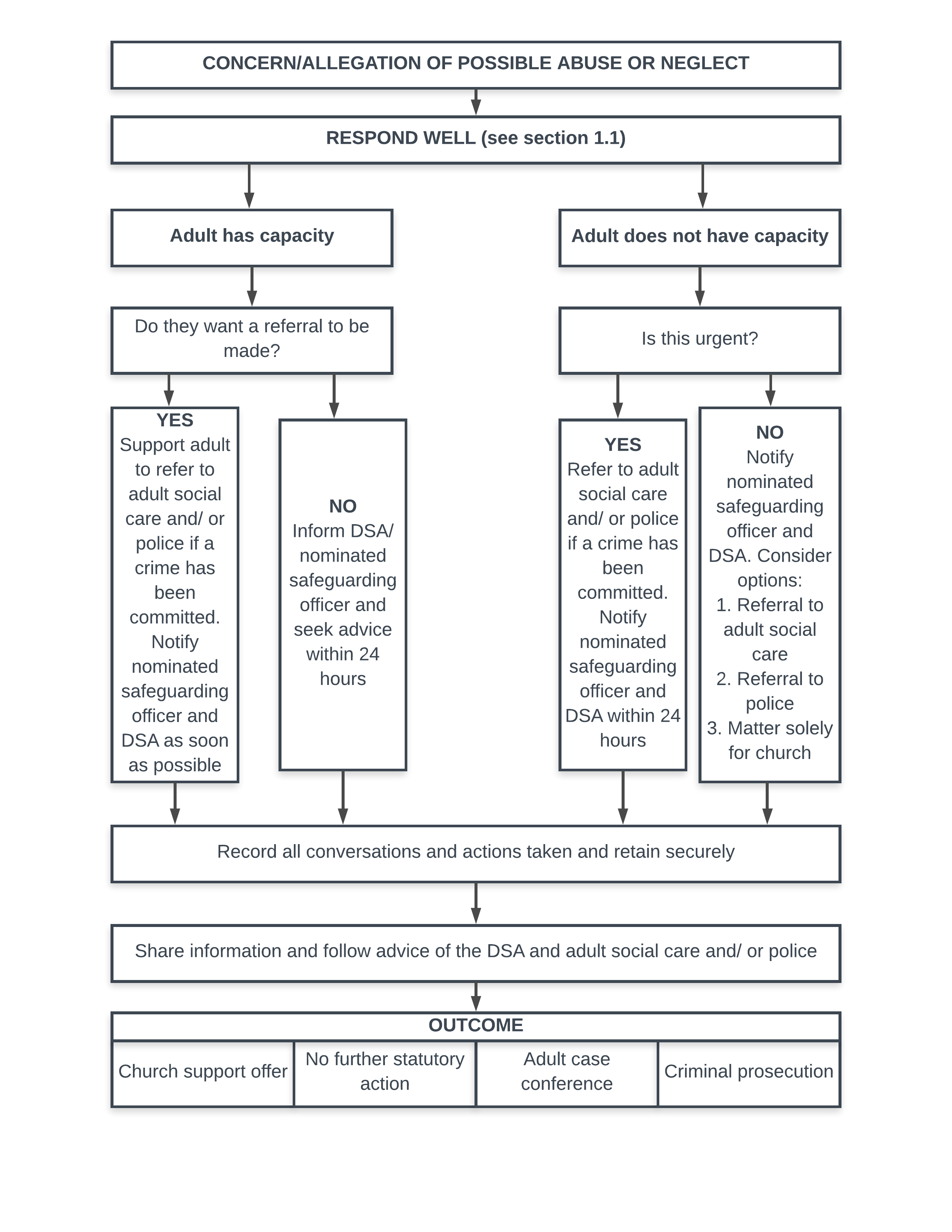
This is the procedure that church officers and bodies must follow if they have a safeguarding concern or allegation about an adult.
3.1. Quick guide
Please note, if an adult is at risk of immediate harm, take yourself out of danger and call the police. Ring 999.
3.2. What will the diocesan safeguarding adviser do?
- Offer advice and support to the church body;
- Consider the safety of the vulnerable adult(s) throughout;
- Check whether a referral to adult social care and/or police is necessary. Agree next steps;
- Consider consent;
- Consider any support needs;
- Record case information;
- Consider whether a safeguarding agreement is required;
- Contact communications colleagues to discuss communications within the Church, if required;
- Inform the diocesan secretary and/or registrar to agree if notification to charity commissions and the insurance company is necessary;
- Consider whether other colleagues or those in other organisations need to be informed, following advice from adult’s social care/police.
3.3. Consent and capacity
Referrals of suspected abuse are made to adult social services and the police. Where possible, for a person over 18, this should be done with their written consent.
The starting point is the presumption that an adult can give consent and has the mental capacity to do so. The provisions of the Mental Capacity Act 2005 are complex, and questions and concerns about consent and mental capacity should always be discussed with the DSA.
Information can be shared legally without consent if a person is unable to or cannot reasonably be expected to gain consent from the individual concerned, or if to gain consent could place somebody at risk. Relevant personal data can be shared lawfully without consent if it is to keep an adult safe from neglect or physical, emotional or mental harm, or if it is protecting their physical, mental or emotional well-being. This is called where there is Substantial Public Interest Concern [15] .
Never make these decisions on your own. If you are going to share personal data, this should always be discussed with the nominated safeguarding officer and/or the DSA. Of course, you may be able to share data, at least initially, without identifying the individual concerned both within the church and with the statutory services.
Ultimately, the most important consideration is whether the sharing of information is likely to support the safeguarding of a vulnerable adult.
3.4. Making a referral to the statutory agencies
- Referrals should be made to adult social care for the area where the adult is living or
is found. If a crime has also been committed, the police should also be contacted. - If the adult is known to have an allocated worker, the referral should be made to them
or, in their absence, to the worker's manager or a duty worker. In all other
circumstances, referrals should be made to the duty officer.
The referrer should confirm verbal and telephone referrals in writing, within 48 hours.
When making a referral, have the information ready wherever possible
Once a decision has been made to make a referral to the statutory agencies, the following information will need to be passed on wherever possible:
- Name, date of birth, and address of the adult;
- Details of any carers;
- Details of GP;
- Nature of the alleged abuse including details of the disclosure;
- What impact the alleged abuse is having on the adult;
- Whether anyone else is at risk of harm;
- The adult’s wishes and feelings;
- Whether consent for referral was given and your view on the adult’s capacity;
- Where the adult is at the time of referral;
- Any known or previous issues of concern;
- Any involvement of the Church prior to and up to the allegation;
- Your name and contact details;
- What the adult has been told will happen next.
If all the information is not available, still pass on what you have. This can be by telephone, although some local authorities prefer online referrals. If it is by telephone, follow up in writing. ‘In writing’ includes email correspondence.
3.5. What to expect from the adult social care [16] and the police
- Adult social care will check previous records to see whether they already know the person.
- They should give you their name and contact details, tell you what action they intend to take, provide advice on your next steps and a timescale for letting you know the outcome of any enquiry (within the limits of confidentiality).
- They will make sure the vulnerable adult is safe and will contact anyone they need information from. An important part is talking to the adult concerned, unless it would put them at risk [17] . A decision will be made within 48 hours about what action is needed. Further enquiries would then be made to look into the issue. The length of time this takes will depend on the issues involved and the person’s wishes.
- Adult social care cannot always provide you with information on what has happened as a result of you making contact with them, as this information is confidential. Sometimes a person may refuse any help that is offered and that is their decision to make.
- The enquiries/investigation may lead to extra care support or a change in the way services are provided. It could mean that the police are involved if a crime may have been committed. It may lead to a decision that the adult is not at risk of harm or neglect, and not eligible for services. Adult social care may refer them to someone else for help.
4. Non-recent abuse
Non-recent abuse (also known as historical abuse) is an allegation of neglect, physical, sexual or emotional abuse made by or on behalf of someone who is now 18 years old or over, relating to an incident which took place when the alleged victim was under 18 years old.
Allegations of child abuse are sometimes made by adults and children many years after the abuse has occurred. There are many reasons for an allegation not being made at the time, including fear of reprisals, the degree of control exercised by the abuser, and shame or fear that the allegation may not be believed. If the person is becoming aware that the abuser is being investigated for a similar matter or suspects that the abuse is continuing against other children, this may trigger the allegation.
Reports of non-recent concerns or allegations of abuse may be complex, as the alleged victims may no longer be living in the same situation where the abuse occurred and/or the whereabouts of the alleged respondent may be unknown. However, such cases should be responded to in the same way as any other safeguarding concern or allegation. That is because:
- There is a likelihood that a person who abused a child/children in the past will have continued and may still be doing so;
- Criminal prosecutions can still take place, despite the fact that the allegations are non-recent in nature and may have taken place many years ago.
5. Recording
All church officers must keep a record of any safeguarding concern or allegation, the details of how the concern or allegation was followed up, and any actions or work subsequently undertaken, whether by the Church or by statutory agencies, and decisions reached. This is because they provide an account of what happened and ensure:
- A history of events;
- Continuity when there are changes of personnel;
- Accountability;
- Evidence in case of any proceedings.
Church bodies should have an agreed case work recording system in place, preferably electronic. This should be secure and have identified restricted access. No case work material should be stored on home computers or in home offices.
When is a safeguarding case file opened?
- If a safeguarding concern is raised about a child or adult.
- When an enquiry or a referral is made to an outside body (e.g. police, LADO, local authority, cathedral, another denomination, etc.).
- If an alert is made about an individual.
- If a concern is raised about a group/day nursery, etc., which is held on Church of England premises.
- Self-referrals, e.g. by survivors.
- If someone in the Church of England seeks advice about an individual.
- If a local church officer seeks advice about an individual from a church safeguarding officer/adviser.
Storage and retention
It is important that all records are kept in a secure place and only shared in accordance with legislation and practice guidelines.
Please note that whilst the Independent Inquiry into Child Sexual Abuse is ongoing, and in accordance with its guidance, all records that relate to safeguarding should be retained. For information on the retention of records, please see the Church’s retention guidance.
6. Church/faith-based issues
6.1. Confession
It is possible that relevant information may be disclosed in a one-to-one confession made to a priest in the context of the sacramental ministry of reconciliation.
Not least because the legal position differs between the two cases, it is important to recognise the distinction between disclosures made in this formal context, which exists for the quieting of conscience and is intended to lead to absolution, and disclosures made in the context of pastoral conversations. In the first case, but not the second, what is disclosed is subject to a duty of absolute confidentiality arising from the unrepealed proviso to Canon 113 of the Code of 1603.
For this reason, a clear distinction should be made between pastoral conversations and confessions made in the context of the ministry of absolution. To that end, it is helpful if confessions are normally only heard at advertised times or by special arrangement, and are in other ways differentiated from general pastoral conversations or meetings for spiritual direction. A stole might be worn and a liturgy should be used. It is also important that those clergy exercising this ministry should have received appropriate training and be familiar with any guidelines published by the House of Bishops in relation to the exercise of this ministry.
If a penitent makes a confession with the intention of receiving absolution, the priest is forbidden from disclosing anything (including any criminal offence) which is revealed in the course of the confession. This requirement of absolute confidentiality applies even after the death of the penitent.
However, where a penitent discloses in the course of such a confession that he/she has committed a serious crime, the priest should require him/her to report it to the police or other statutory authority and should withhold absolution if the penitent refuses to do so. In such a case, the priest may consider it necessary to alert the bishop or the bishop’s adviser for the ministry of reconciliation (if there is one) to his/her decision, though the penitent's details should not be shared without their permission.
The canonical duty of absolute confidentiality does not apply to anything that is said outside the context of a confession made in the context of the ministry of absolution. In particular, if information about abuse that was disclosed when seeking the ministry of absolution is repeated by a penitent outside that context, the priest should report the abuse in the usual way.
6.2. Spiritual direction
As with any other pastoral relationship, care should be taken to set parameters to the spiritual direction or spiritual accompanier relationship. It should, therefore, be made clear at the beginning of the relationship that disclosures of abuse will be reported to a DSA and, possibly, the statutory agencies; a reminder will be appropriate if it appears that such material may arise. Someone may speak of his/her own behaviour in harming a child, or the person may be an adult speaking of historical abuse from his/her own childhood. The latter is more difficult as the directee may be unwilling to reveal, or not even know, names. The possibility that an abuser who is still alive may still be abusing children will likely be an imperative to encourage an adult survivor of abuse to approach the police. At the right time this may prove to be part of the healing process, as well as serve to protect children in the current time.
Any safeguarding concerns must be reported to the nominated safeguarding officer and/or DSA.
6.3. Ministry of healing
All clergy undertaking the ministry of healing should be familiar with, and follow, the current House of Bishops' Guidelines for Good Practice in the Healing Ministry [18] . Local diocesan guidance should be followed. Professional boundaries with health care professionals and chaplaincies should be observed. All reasonable steps should be taken to ensure the safety of the person receiving the healing ministry, which will include ensuring that satisfactory arrangements are in place for training and accountability for those undertaking this ministry.
The clergy should be aware of and respect the boundaries between the ministry of healing and the deliverance ministry. People have a right to know what is being provided and how they will be ministered to; no one should be ministered to against his/her will [19] .
Any safeguarding concerns must be reported to the nominated safeguarding officer and/or DSA.
6.4. Ministry of deliverance
It is sometimes suggested that a child, young person or adult is troubled by or possessed by evil spirits or demons, and that this may account for behavioural issues in the individual or be considered to justify harsh treatment by the family, guardians, friends or carers, who may seek advice and assistance from clergy or other church members. Parish priests, lay ministers and others involved in such situations should consult the bishop, the diocesan safeguarding adviser and the diocesan deliverance ministry adviser.
Many people seeking reassurance, advice and help with regards to deliverance ministry have vulnerabilities, including spiritual distress and mental health concerns. Deliverance is an area of ministry where particular caution needs to be exercised, especially when ministering to someone who is in a disturbed state. The House of Bishops' Guidelines for Good Practice in the Healing Ministry (2000) and the House of Bishops’ Guidelines for Good Practice in the Deliverance Ministry 1975 (revised in 2012) should be followed and cases referred to the diocesan deliverance ministry advisers when necessary. The advisers' special expertise should be used in order to help those who think they need this ministry as effectively as possible.
The House of Bishops’ Guidelines on the Deliverance Ministry, which originated in 1975, were revised and reissued in 2012. They continue to state that the following factors should be borne in mind:
- It should be done in collaboration with the resources of medicine;
- It should be done in the context of prayer and sacrament;
- It should be done with the minimum of publicity;
- It should be done by experienced persons authorised by the diocesan bishop;
- It should be followed up by continuing pastoral care.
The ministry of deliverance may only be exercised by a priest who has been specifically and personally authorised by the diocesan bishop, who normally requires that permission be obtained from him/her for each specific exercise of such a ministry. This ministry should never be undertaken by one person ministering alone; the authorised person should always be accompanied by another priest or lay minister of mature pastoral experience, who is similarly authorised by the diocesan bishop to exercise the ministry of deliverance.
On occasions when deliverance is administered, it is for the bishop to determine the nature of the rite and what form of words should be used.
If deliverance ministry is sought in connection with a child, young person or adult who may be vulnerable, the diocesan safeguarding adviser must be involved and may need to ensure that a referral to the statutory authorities is made, in accordance with national and diocesan safeguarding policies.
Diocesan safeguarding advisers should make themselves known to the diocesan deliverance ministry advisers and the diocesan deliverance ministry group in advance of any specific case, in order to ensure that there is mutual understanding of policy and working methods and that cases arising are appropriately brought to notice.
Diocesan safeguarding advisers should agree with the diocesan deliverance ministry advisers and diocesan deliverance ministry group, in advance of any specific case, on protocols for inter-disciplinary cooperation, in order to ensure that any cases arising are appropriately handled. The deliverance advisers and safeguarding advisers should also agree on with whom the prime responsibility lies for the continuing pastoral care of individuals in deliverance ministry cases which include safeguarding concerns [20] .
- The diocesan safeguarding adviser (DSA) is a paid worker who is professionally qualified and experienced in safeguarding practice. They advise and support the diocese on all safeguarding matters. In this guidance, the term may also apply to a provincial safeguarding adviser (PSA) and members of the National Safeguarding Team (NST). In addition, other Church bodies have safeguarding officers, safeguarding leads or a designated/nominated safeguarding person. These roles may either be specialist paid roles, part of a wider paid role or unpaid, as required. For the purpose of this guidance, the term nominated safeguarding officer is used. This guidance reinforces that all concerns or allegations need to be reported to and discussed with the DSA.
- Church bodies include PCCs, diocesan bodies, cathedrals, religious communities, theological educational institutions and the National Church Institutions. This practice guidance will apply to the whole of the provinces of Canterbury and York (including the diocese in Europe subject to local variations/modifications). There is also an expectation that the guidance will apply to the Channel Islands and Sodor and Man, unless there is specific local legislation in a jurisdiction that would prevent adoption.
- A ’church officer’ is anyone appointed/elected by or on behalf of the Church to a post or role, whether they are ordained or lay, paid or unpaid.
- For most church bodies this will be the DSA
- Information on signs and symptoms of abuse can be found in the Types of Abuse Fact Sheet
- The exemption would be if information has been shared within the Seal of the Confession (see section 6.1).
- See the UK government guidance Working Together to Safeguard Children
- It is not all in force yet; the planned new developments in paying for care will not now take effect until April 2020.
- Information on signs and symptoms of abuse can be found in the Types of Abuse Fact Sheet.
- See the UK government guidance, Care and Support Statutory Guidance
- The statutory definition in the Children Act 1989 states that 'harm' means ill-treatment or impairment of health and development. Ill-treatment includes sexual abuse and forms of ill-treatment which are not physical, thus including emotional abuse. Physical abuse itself is not explicitly included, but this is taken as read. 'Health' includes both physical and mental health, and 'development' includes physical, intellectual, emotional, social and behavioural development. To assess whether health or development are being significantly impaired, the Act tells us to compare the health or development of the child in question 'with that which could reasonably be expected of a similar child'. The definition of harm also includes 'impairment suffered from seeing or hearing the ill-treatment of another.'
- Please note, children’s social care will always contact the police if required.
- Under section 47 of the Children Act 1989, where a local authority has reasonable cause to suspect that a child (who lives or is found in their area) is suffering or is likely to suffer significant harm, it has a duty to make such enquiries as it considers necessary to decide whether to take any action to safeguard or promote the child’s welfare.
- Section 17 of the Children Act 1989 states that it is the general duty of every local authority to safeguard and promote the welfare of children within their area who are in need; and, so far as it is consistent with that duty, to promote the upbringing of such children by their families
- Please see the Data Protection Act 2018
- This is outlined in the Care Act 2014
- They have a duty to ensure the person is safe from harm and aim to progress an enquiry (section 42, Care Act 2014) as soon as possible, including seeing the person.
- House of Bishops’ Guidelines for Good Practice in the Healing Ministry (2000).
- Extract from the Guidelines for the Professional Conduct of Clergy (2015).
- Please see section 5 of Ministry at Times of Deepest Need in the Guidelines for Professional Conduct of the Clergy (2015).