
Training and Development Practice Guidance
Preface
Dear Colleagues,
This Practice Guidance has been commended by the House of Bishops and is designed to ensure a framework of consistent training and development of safeguarding practice in the context of the Church. It should be read alongside ‘Promoting a Safer Church: a policy for safeguarding children and adults, 2017’. The care and protection of children, young people and adults involved in Church activities is the responsibility of the whole Church and is an essential part of our commitment to live out the gospel of Jesus Christ. Everyone who participates in the life of the Church therefore has a role to play in Promoting a Safer Church for all.
This Practice Guidance is for use by Diocesan, Provincial and National Safeguarding Advisers, Archbishops and Bishops, Deans and their senior staff. It is designed to inform and assist us all in resourcing and designing the delivery of safeguarding training, for ordained and lay people at different stages of their ministry. This guidance applies to safeguarding learning in parish, diocesan and provincial contexts and applies to all Church bodies and officers. The clear intention is that full understanding of, and adherence to, this policy and guidance will lead to a deeper understanding of, and respect for, the rights of children, young people and vulnerable adults as people of faith in the life of the Church. It is part of our duty of care as a Church that we commit ourselves to work to achieve this.
This very significant document contains resources and guidance which are clear, stimulating and yet also challenging. I am pleased to commend it to you whilst at the same time drawing your attention to the fact that failure to implement and have due regard to it may result in disciplinary action. The Ecclesiastical Insurance Group has also made it clear that their insurance cover is only valid where House of Bishops safeguarding policy and practice guidance is being followed.
I am grateful to our colleagues on the National Safeguarding Team who are, as ever, ready to support us or respond to any enquiries or concerns which we may have. I hope you will find this practice guidance helpful.
Yours in Christ's fellowship,
The Rt Revd Peter Hancock
Bishop of Bath and Wells
Lead Bishop on Safeguarding
Introduction
Structure and use of document
This document sets out the framework to ensure that all Church officers [*] are trained in aspects of safeguarding relevant to their role in order to develop and maintain the necessary knowledge, attitude and skills to safeguard and protect children, young people, vulnerable adults [*] as outlined in ‘Promoting a Safer Church: a policy for safeguarding children and adults, 2016’.
It replaces and updates the ‘House of Bishops Learning and Development Framework Practice Guidance’ 2015.
It aims to continue to ensure that the Church of England complies with ‘Working Together to Safeguard Children (2015)’ [*] . Since March 2013 the Government guidance has explicitly stated that faith organisations are expected to adhere to the same standards as statutory organisations within the safeguarding sector, such as adult / children’s services, police, health, education.
The framework sets out:
- the expectations and requirements for safeguarding training and development in the church context, and how this relates to statutory requirements;
- the elements of church safeguarding training and the requirements for delivery;
- details of the range of core training modules, including learning aims and objectives, and expectations and requirements to undertake training by role;
- details of the range of specialist training modules, including learning aims and objectives, and expectations and requirements to undertake training by role;
- proposals for implementation of the framework.
This practice guidance is for use by Diocesan, Provincial and National Safeguarding Advisers, Archbishops and Bishops, Deans and their senior staff.
There is a range of core and specialist training modules and materials, referenced in the document, produced and available on the ‘Safeguarding Hub [*] ’. These can be adapted for local use, as required – see section 3.3. Flexibility of Delivery.
This framework sits within a suite of associated House of Bishops Policy and Practice Guidance documents [*] .
Building on this, Church bodies may provide additional local training and development opportunities in line with the House of Bishops policy and practice guidance.
Scope
This policy and practice guidance applies to all Church bodies and officers [*] . Full understanding of, and adherence to, this policy and guidance should lead to a deepening in the understanding of, and respect for, the rights of children, young people and vulnerable adults as people of faith in the life of the Church.
The care and protection of children, young people and adults involved in Church activities is the responsibility of the whole Church. Everyone who participates in the life of the Church has a role to play in promoting a Safer Church for all.
This practice guidance applies to all Church officers and failure to comply with the House of Bishops policy and practice guidance may result in disciplinary action. In addition under the Safeguarding and Clergy Discipline Measure 2016 [*] , all clergy and relevant church officers (e.g. churchwardens, licensed readers, PCCs) must have ‘due regard’ to safeguarding guidance (which will includes both policy and practice guidance) issued by the House of Bishops. A duty to have ‘due regard’ to guidance means that the person under the duty is not free to disregard it but is required to follow such guidance unless there are cogent reasons for not doing so, (e.g. because it is out of date). Failure to comply with this provision may result in disciplinary action.
1. Training and Development Policy
Learning in the church context takes account of the specific roles and context of the church environment. All Church bodies will encourage the provision of supervision and training in order to ensure that:
● Consistent training of the highest quality is offered to all Church officers who work with children, young people and adults who may be vulnerable in every Christian community, and at every stage of ministry.
● All Church officers are trained in aspects of safeguarding relevant to and commensurate with their role.
● All training courses will be informed by and support the implementation of the House of Bishops policy and practice guidance.
● All those who work with children, young people and adults who may be vulnerable are inducted into the Church body’s policy and procedures on safeguarding.
● Each Church body conducts an annual training needs analysis that identifies all church officers (ordained/lay/paid/unpaid) who require training, and develops a training plan based on this. That this training is monitored and refreshed every three years.
● Church bodies ensure delivery at a local level of core and specialist training modules, in line with the House of Bishops practice guidance, as rolled out by the National Safeguarding Team, where they have been identified as necessary through the training needs analysis.
● Identified Church personnel are provided with appropriate continual professional development in line with their professional registration requirements.
● Training programmes as rolled out by the National Safeguarding Team and outlined in the House of Bishops framework are delivered and updated in line with current legislation, guidance and best practice.
● The Church body facilitates the provision of an appropriate level of support to all involved with the delivery of safeguarding training.
1.1. Putting the policy into action
Evidence of providing training and development opportunities for safeguarding may include:
- induction documentation/guidance;
- training needs analysis demonstrating the requirements for core and specialist modules have been considered;
- a copy of training plans/programmes demonstrating role specific safeguarding training;
- tracking training, gaps and required refreshers for church officers;
- records of course attendance;
- course evaluation documents;
- guidance for including safeguarding in formation and Ministerial Development Reviews;
- raising awareness of safeguarding work with all members of church communities;
- ensuring access to regular support and supervision for safeguarding trainers.
2. The church context
2.1. Safeguarding training and development in the church context
Christian communities are ‘open communities’ and families in God. We encourage people to belong and to befriend and care for one another; some of this happens outside the confines of the church, in places where church officers have little control. Church communities are vulnerable to those who seek to harm others, because of the opportunities for grooming not just children, but also their families, their priests and leaders, as well as the whole church community.
Training needs to encourage a culture of ‘respectful uncertainty’. Training for different church roles needs to include safer working practices which emphasise the importance of maintaining proper boundaries at all times.
2.2. Responding well to those who have been abused
Safeguarding training needs to address the needs of both children and adults, who may come to the church for help arising from abuse experienced within the church, the wider community or in families (where the majority of abuse takes place).
Training needs to equip leaders to respond sensitively and in a timely manner to each person reporting abuse, whilst also taking the safeguarding action that is required to protect others. It has to address the reality of the abuse of adults by those in positions of authority within the Church, especially clergy at any level of seniority.
2.3. Safe working practice
Most Church officers are volunteers, and are not trained professionally to work with children or adults. Church officers are not expected to investigate, for them to do so would be dangerous practice. The primary obligation is to refer safeguarding concerns to statutory agencies for their investigation. For their own protection as well as for the protection of those in their care, Church officers need guidance on safe working practice, which includes knowing when they should be concerned, from whom they should seek advice, when and how to refer and the detail of records to be kept.
2.4. Needs of participants in training
The vulnerabilities, resilience and competence of those participating in training need to be taken into account. Many are volunteers with no previous safeguarding experience, and a significant number of them will have experienced abuse themselves (it is a regular experience for at least one person to disclose abuse to trainers during a church safeguarding training session). No-one should be unduly distressed or undermined by church training.
In addition, participants need the opportunity to explore with the trainers and one another the particular and complex challenges which they face in their ministry and work with children and adults who may be vulnerable.
When delivered by the Diocesan Safeguarding Adviser and/or parish officers, training provides a valuable opportunity to develop a trusted working relationship.
The core modules C0 and C1 are available in both online and face to face training formats with Church bodies having the discretion to decide on the best delivery model. Online modules have clear signposting within them so that anyone with immediate needs arising from the training content can be responded to appropriately. The other core safeguarding modules are for face to face delivery so that a response can be made to any immediate need.
Participants in training are also likely to need some opportunity to reflect on the relationship between safeguarding issues and their faith (see 2.3 above).
Participants in training may have additional needs which impact on their ability to learn, for example, literacy or sight and/or hearing impairments. Where training is completed online, the format of the material is such that all written content is also available audibly at the click of a button. Face to face training should always be delivered by two people as explained in section 3.2 in order that appropriate support can be offered. Participants may also wish to bring along a supporter who can assist them during the training to engage in the materials.
2.5. Specialist training needs
Beyond the requirements of core safeguarding training, high quality training across a whole range of more specialist safeguarding subjects is being made available.
Church officers, and particularly those in leadership positions, also need specialist training in safeguarding issues such as safer recruitment (S1); pastoral relationships, confidentiality and confession (S2); domestic abuse/ violence (S3); grooming, sexual abuse and responding to survivors (S4); assessing and managing risk (S5); spiritual abuse (S6) and training for Support Person and link persons (S7). These specialist modules are under development however, the development and release of these modules is dependent on the approval of policy and practice guidance by the House of Bishops.
Further specialist training is also being considered for national roll out
3. Modular safeguarding training
Safeguarding is everyone’s responsibility. Core safeguarding training modules aim to promote a safer church across church communities from members of our congregations to our senior leaders. Whilst for some completion of safeguarding training is an expectation as we strive to achieve best practice, for others it is a mandatory requirement for the role that they fulfil.
A modular programme builds core, generic safeguarding training according to role, and through a person’s ministry path. The programme also identifies specialist areas of training which will be necessary for some roles dependent on the person’s ministry. Refresher modules at regular intervals will keep knowledge and skills up to date. These will need to reflect the participants’ roles and previous training undertaken. Participants at this stage may benefit from mixed groups to encourage team working between lay and ordained, and across a variety of roles.
It is recognised nationally that the effective implementation of this framework depends on adequate resourcing for safeguarding training, including appropriate levels of administrative support.
3.1. Elements of safeguarding training
Taking into account the church context, all training needs to:
- focus on developing healthy safeguarding practice;
- integrate safeguarding training relating to work with children, young people and adults so as broaden knowledge within our church communities;
- equip participants to understand what might be a safeguarding concern, how to recognise the signs and symptoms of abuse, know how to respond well, and know who they can and should contact, without overloading them with information relevant only to safeguarding professionals;
- include many and varied examples of what abuse can look like, particularly within our church communities;
- be participative in style and content, and build on the knowledge base of participants, emphasising the need to work together;
- pay attention to leaders’ own vulnerabilities in the caring roles they fulfill, and how they can protect themselves and others by working safely;
- provide opportunities for participants to relate their learning to their faith and take responsibility for their own development.
3.2. Delivery
- Safeguarding training must be delivered by experienced and skilled trainers, who understand the statutory requirements of safeguarding children and adults, and how these are executed in the church context.
- Not all Diocesan Safeguarding Advisers will have training skills; if they do not deliver training directly, it is vital that they set up alternative methods for routine engagement with church officers.
- Modules designed for face to face participative learning should be delivered to groups of ideally a maximum of 30, although competent trainers may manage up to 40 [*] .
- The C0 Basic Awareness, C1 Foundation and C5 Refresher modules are available for online delivery via e-learning resources, with the option of delivering the material face to face where preferred or required. Further online learning opportunities will be explored for other modules where this would facilitate implementation.
- Every face to face training session should be facilitated by two people: either two trainers, or one trainer and one experienced and skilled coworker, in order that the needs of participants can be fully addressed.
- For consistency of delivery and content, national training modules will be rolled out by the National Safeguarding Team by way of regional sessions. Church bodies will be asked to identify trainers for training by the NST. After the roll out sessions additional training for trainers will not be provided by the NST and it will become the responsibility of church bodies to train any additional trainers.
In the different church bodies consideration should be given to the best model to deliver training, in some contexts, training could be delivered across parishes, deaneries or mission units utilising volunteer trainers and officially commissioning them where appropriate. Cathedrals, Religious Communities and Theological Educational Institutions should consider, together with the diocese in which they are located, the best methods for ensuring that all relevant Church officers are engaged in the appropriate level of safeguarding training either by delivering independently or by sharing resources.
Where volunteers are recruited for training delivery it is essential that they are provided with full training by the DSA in training delivery principles and the module materials. Ongoing oversight and support should be offered to volunteer trainers to ensure that they are resourced for the important work they are undertaking and that training standards are maintained – oversight and support may include observations of training delivery.
In the diocesan context there is an expectation that the increased national training resource will be matched by an increased diocesan resource, and that safeguarding training for clergy should be integrated with IME Phase II and Continuing Ministerial Development.
The National Safeguarding Team will work with Ministry Division and others to develop the potential for ‘blended learning’, this will be achieved through an on-line training portal to support face to face training. The on-line portal will house a resource bank for training materials, exercises and case studies to be available for download; some module materials to be accessed prior to face to face sessions; opportunities for personal reflection post courses and an online discussion forum.
3.3. Flexibility of delivery
Core material will be provided for each module, and trainers’ notes and training for trainers will be included. The national modules as released are the ‘national minimum standard’ and should be delivered in their released format in order to ensure there is a consistent minimum level of training being delivered across the Church of England. These base materials should be used as the skeleton around which Church bodies build their modules for local delivery and can be supplemented with locally relevant resources, case studies, exercises etc. to bring the training to life for the participants at each course delivered.
Flexibility in delivery is encouraged in a number of ways:
- to maximise resources and ensure consistency of practice. For example dioceses, cathedrals or TEIs may wish to consider joint appointments of safeguarding training officers or sharing resources to deliver some modules regionally;
- to make material specific for the particular needs, demands, culture and location of the participant group, with the avoidance where possible of repetition for those who have already completed other modules. For example, the specialist module materials will contain extensive material in order to train those requiring the most in-depth knowledge, where groups require only an awareness of the specialist area the material could be condensed in order to cover key messages rather than the full spectrum;
- to use a range of teaching and learning styles which build on the strengths, knowledge and skills of the trainers and the needs of the participants;
- to combine modules to reflect local priorities, needs and resources. For example, modules C1 and C2 could be combined; modules C3 and S2 could be combined; the contents of C3 can be reduced if participants have already completed C1 and C2.
- to time and space training opportunities in the best way possible in order to achieve maximum engagement. For example, rather than a single full day session the C3 module could be split into two half day sessions.
3.4. Core safeguarding modules
The modules provide a framework for national/diocesan/cathedral/TEI safeguarding training strategies [*] . Each module has key learning aims and objectives (see section 4 and Appendix 2).
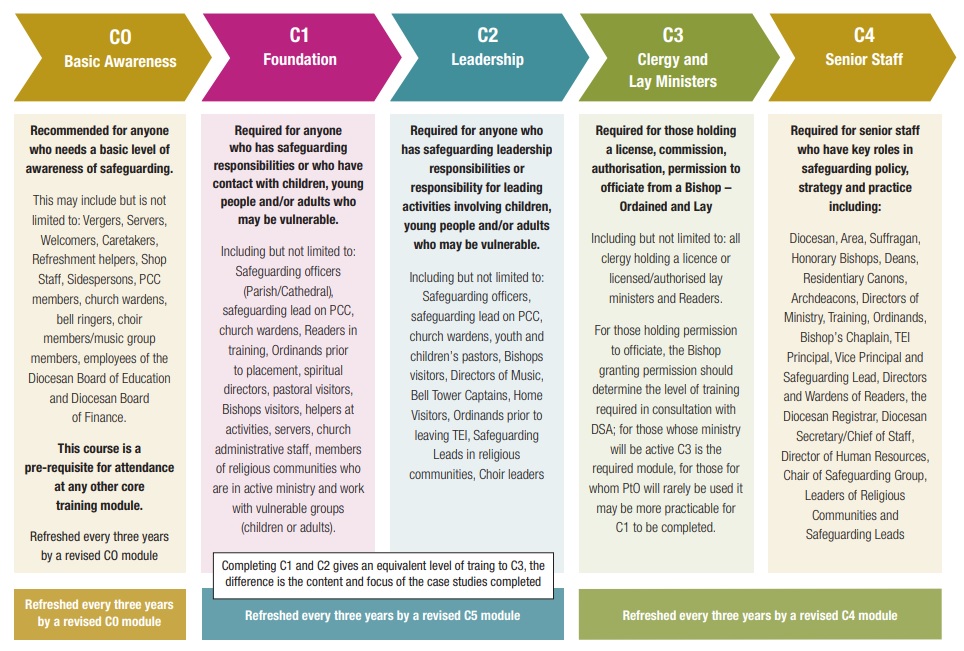
The diagram at the end of this section shows the expectations and requirements for attendance at core safeguarding training modules. Modules to be completed are dependent on the role that the person requiring training undertakes in relation to their involvement with children, young people and adults who may be vulnerable. Those who hold positions of responsibility for activities undertaken with children, young people and/or adults who may be vulnerable will require more in-depth training than those who assist in the running of activities. For example, the person in charge of a youth group will require training to C2 (Leadership) level whereas a volunteer acting as an additional adult at a youth group session, but is never the leader of the activity, would require training to C1 level.
Where training is ‘recommended’, it is not compulsory, for example the C0 module. However, where training is required or essential those modules are mandatory requirements. The requirements and expectations of training have been set based on the functions and levels of responsibility and/or leadership of the roles listed.
A number of dioceses are known to have purchased e-learning courses in their own right which fulfil the function of C0. The National Safeguarding Team are content for those courses to continue to be used but accept no responsibility for the accuracy of the material, continued updating of that material or correlation with the national materials.
All dioceses who continue to use their own e-learning resources will be requested to supply data on the numbers of completions of e-learning to the National Safeguarding Team annually and to adopt the NST policy of e-learning being completed as a pre-requisite for attendance at any other core training module (C1-C4).
No accreditation is given against the core safeguarding training modules for prior learning that has not been provided by the Church of England framework. This is due to church core safeguarding training modules situating safeguarding practice within the unique context of the church and providing participants with the opportunity to relate their learning to their faith.
Where prior learning has been completed in relation to the specialist modules, the Diocesan Bishop, in consultation with the Diocesan Safeguarding Adviser, will be able to exercise discretion in giving accreditation for prior learning. For example, where a person requires training in safer recruitment but has completed an employment based safer recruitment training package within the last 12 months they may be considered sufficient for them in fulfilling their Church related responsibilities and discretion may be used.
There may be some extenuating circumstances in which Bishops may wish to exercise a degree of discretion in implementing the requirements for training, for example with clergy who because of infirmity never exercise their permission to officiate. The Bishop should seek the advice of the Diocesan Safeguarding Adviser prior to giving discretion. If the PtO is being exercised – no matter how limited the circumstances – there remains a requirement for training but it may be that C1 is a more appropriate level than C3. Where such discretion is exercised, the Bishop should record it in the blue file of any clergyperson or the appropriate record of lay ministers.
3.5. Specialist safeguarding modules
3.6. Monitoring of delivery and learning
3.7. Embedding safeguarding training
4. Module learning aims, objectives and goals